
When the right people join your team, it streamlines all the processes and boosts your company’s performance. However, recruiting is a complex procedure that involves crafting a job description, posting it to relevant platforms, conducting interviews, assessing candidates, and onboarding newcomers.
And as dealing with all these tasks is challenging, spending, and time-consuming, many businesses prefer recruitment process outsourcing. Read on to learn more about this approach to hiring staff.
What Is Recruitment Process Outsourcing (RPO)?

Source: https://mobilunity.com/offshoring-wiki/rpo-recruiting-process-outsourcing/
Recruitment process outsourcing or RPO assumes that you delegate finding new team members to another company. Businesses can outsource the whole process or some of its stages from an RPO provider. This way, companies engage outsourcing providers to assist their in-house recruiters or completely pass the HR functions to a third party.
However, before trusting your most valuable resource to an external company, make sure it has several years of experience in your industry and has operated in your country of interest. Check how long your potential HR partners will need to find a new employee and if they’re ready to meet your terms for assembling teams. Also, ask if they provide any guarantees for the closed positions.
Main Types of RPO Staffing Services

Source: https://mobilunity.com/offshoring-wiki/rpo-recruiting-process-outsourcing/
Depending on the current needs, organizations can use one of the four RPO forms:
- Recruiters on demand (ROD). This is the most flexible RPO model because outsourced services can change frequently. Assume, last month, you asked to craft a Junior NET. Engineer’s job description, and now you need to arrange top-level interviews with senior Python developers.
- Selective RPO. Delegating the whole stack of recruitment services isn’t always necessary, so some businesses require outsourcing only one or several HR functions. For example, contracting only candidate sourcing or screening can help avoid bottlenecks and ensure a smooth recruitment process.
- Project RPO. Once you need recruiting and HR assistance for several months, the Project RPO solution best fits this demand. By signing the contract for a limited period, companies agree that the staffing company will fulfill all the HR-related obligations before it expires.
- End-to-end RPO. This outsourcing format assumes you delegate the whole employee life cycle to an RPO company. With this cooperation plan, the provider is responsible for everything related to the company’s staff, and such collaboration can last for years.
5 Reasons to Outsource Employee Hiring Process
Now let’s check why outsourcing recruiting services is excellent for your business. The recruitment process outsourcing:
1. It is cost-effective.
You’ll have to pay for advertising on various job listing resources, buy additional software to manage candidates’ data, and cover recruitment fees once you look for a new employee. But staffing RPO can help you significantly cut costs on hiring. These companies boast an extensive network of partners, leverage bulk subscription plans onion posting resources, use advanced software, and build effective processes.
These factors allow outsourcing providers’ clients to benefit from lower prices, streamlined workflows, and recruiters with higher qualifications. Faster onboarding of the approved candidate also means that you lose less revenue each day your vacancy stays open, and the work remains undone. Moreover, with an RPO, you protect your company from bad hires, resulting in higher turnover and training expenses.
2. It is quicker.
Traditional in-house recruitment may take up to several months to find a middle-level professional. And often, for communicational and technical reasons, corporate recruiters lack consistency. This can make the process less effective, leaving a top-priority vacancy open for months. But RPO specialists leverage the latest recruitment tech stacks and streamline their processes to meet the deadlines.
This way, the time between your first call to the recruitment process outsourcing agent and the day when you greet your new team member can be from three to six weeks. This term will depend on the required level of expertise for your position, dedicated team structure, and the market situation in the country you plan to hire from.
3. Lets you hire top experts.
RPO providers usually have talent acquisition teams that ensure your company has access to top-notch experts almost immediately. That’s because any remote talent sourcing agents provider accumulates specialists with demanded skills into so-called pools. And once RPO entities have a client looking for such an employee, they quickly offer several candidates to consider.
Attracting highly-skilled talents requires a lot of effort and time, but RPO specialists take on this burden from you. They create your Employer Value Proposition listing the benefits your future employee gets. By describing your corporate culture, outsourced recruiters maximize the chances of hiring your best match while you concentrate on business tasks.
4. It is scalable.
The RPO teams arrange their workflows to adapt to sudden growths and decreases in recruiting activities. For instance, your RPO partner’s IT recruitment services will remain effective if they get an urgent order to assemble several dedicated teams of backend developers. This will be possible due to the combination of several factors.
Among them are years of experience in the industry, number of employees and partners around the globe, software used, and working principles.
The flexible recruitment processes are also beneficial once you need to pause your project for a while. In this case, you only pay for the services you use.
5. Lets you stay focused on project tasks.
If you don’t have on-premise recruiters, involving in hiring can affect your core business. That’s because looking for candidates includes multiple tasks that need to be completed shortly. And each stage requires hours of hard work taken away from your core activities. A recruitment process outsourcing provider takes these pains away, letting you work hard on generating revenues.
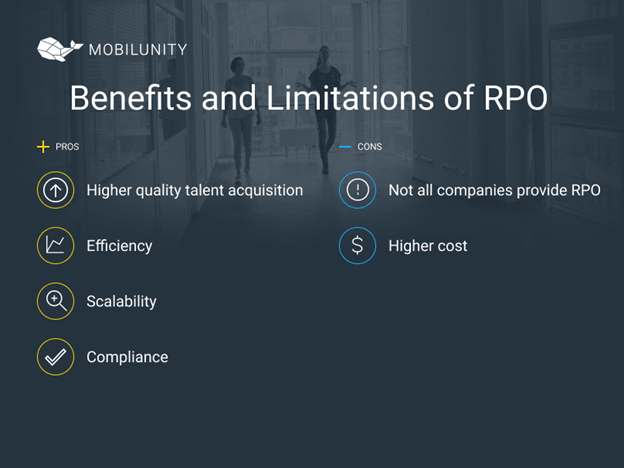
Moreover, you won’t need to worry about staying compliant with local labor laws. This is beneficial as official bodies regularly update their requirements to salary and related tax calculations, various contributions, dates of report submission, etc. And even if your HR team can successfully run payrolls and meet current requirements, it won’t be able to do the same for the staff outsourced from different countries. In the infographics below, we’ve highlighted the pros and cons of the RPO:
Source: https://mobilunity.com/offshoring-wiki/rpo-recruiting-process-outsourcing/
Summing Up
Hiring isn’t easy, especially if you’re a small company with no HR team on board. But even with in-office recruiters, it’s often challenging to find skilled specialists before the deadline.
While bad hires result in higher employee turnover and significant expenses on training, addressing RPO companies will help you get top-notch professionals rapidly and keep your business running smoothly.