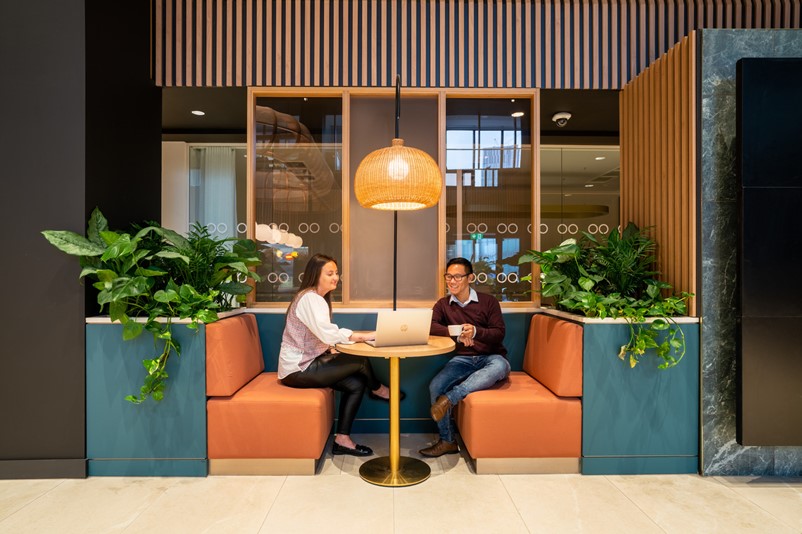
A new survey by flex space operator, Orega reveals that the wellbeing of staff remains high on the agenda for business leaders considering their property requirements – second only to that of cost.
The independent survey* of 500 business leaders and 2,000 UK office workers revealed that whilst 87% of business leaders said that the cost of office space is the key driver in making their property decisions, wellbeing of staff (at 85%) came a close second and employee ease of travel (81%) third.
These indicate that concerns about looking after and retaining staff are still high priorities on the agenda for business leaders as we emerge post pandemic.
How important are the following considerations when making decisions about your office?
Orega’s survey also reveals how the pandemic and “working from home” continue to radically change businesses’ views of methods of work, space requirements and attitudes to leases:
Hybrid Ways of Working Now Supported by Employers – Return to Five Days in The Office Unlikely
The survey confirms the massive shift in working patterns with 58% of employees saying they are embracing a hybrid way of working, most commonly working three days in the office and two remotely. Pre pandemic, hybrid working was only practiced by 22% of workers with 73% of workers coming into the office 5 days a week and 5% of staff working from home. Now only 27% of workers come into the office every day with 15% working full time from home.
This new trend has found favour with employees – with 40% of those surveyed saying new methods of working have helped their mental health.
Happily, most employers also seem to be happy with this trend. From our survey of 500 business leaders, 56% said they prefer their staff to do a mixture of working from home and in the office, a significant increase from just a year ago- 48% in 2021. 44% also said they felt remote working during the pandemic had had no impact on productivity.
Employers therefore seem to have become more confident about their employees moving to hybrid working – particularly in London where 64% of business leaders supported hybrid working, perhaps due to the associated extra travel costs to the capital and to keep staff happy.
However new working trends have also focused businesses on what they need from their offices. 83% of businesses said they wanted staff to attend the office for the benefits of collaboration and communication, 78% for focus and productivity and 75% to stimulate creativity and inspiration.
Employees seem to feel similarly with 57% of employees also giving the office a high score as a social hub. The office is by no means dead – it’s just changing and being used for other purposes.
Impact on Attitude to Space?
These new means of working is having an impact on office requirements. Over a third, (37%) of businesses (and 42% in London) said they plan to reduce their space requirements, particularly high for businesses in Banking, Finance, and Insurance (51%), Energy & Water (50%) and Transport & Communications (48%).
Although only 12% of businesses plan to cut office space by more than a half, the majority (53%) plan to reduce space by a sizeable 20 – 50% and 29% to under 10%.
Only 10% of businesses surveyed planned to look for larger offices.
Many firms do not know what they will need in the long term so having the freedom to upsize and downsize is crucial. There seems to be a post-pandemic desire to move to alternative models with flex space becoming a more attractive proposition. The survey revealed interest in using a hub and spoke model of working – in the main office most of the time and then from a local serviced office near to the employee’s home.
A substantial 59% of businesses surveyed said they would consider some form of serviced office. This was higher in London and the South whereby 61% and 59% respectfully of business leaders said they would consider such offices.
42% of office workers also stated they would like to work in the office and near home in flex or serviced office space rather than working from home, a figure that rose to 45% among men and 44% among the 16-30 aged group.
A Flight to ESG and quality and what employees want from their office- ,privacy and a quiet place to work
There also appeared to be a flight to quality in terms of office space- to some extent responding to employee demands.
Employees were also keen to point out what was most important to them about the office and the facilities they most valued. Attitudes were consistent across all the age ranges.
High on the list were environmental issues such as fresh clean air (73%,) suitable and controllable temperature ( 72%) and direct access to natural light (71%). The ability to develop relationships with colleagues, (73%) , a quiet space to concentrate (69%) and privacy (62%) scored highly too.
Interestingly down the bottom of the list were facilities such as barista-style coffee services (29%), gyms (25%) and connections to other businesses in the same building. Indeed 74% of respondents said this was not important (voted 1-6).
This shatters the myth that many business owners believe- that they need to have fancy or expensive amenities into offices. And it contradicts the perception among many serviced office providers that workers want to mix and have exposure to workers in other businesses, a belief that this would be particularly attractive to young workers,
Over 70% of the 16–34-year-olds surveyed said their priorities for the office were to provide quiet spaces to concentrate (70%), fresh clean air (73%), have controllable temperature (72%) and direct access to natural light (71%). 73% also mentioned the benefit of access to colleagues. Given the difficulties many young people faced as they tried to work from home in unsuitable accommodation, a good office environment certainly has its attractions.
On a scale of 1-10, where 1 is not important at all and 10 is very important, how important are each of the following as factors in getting the most from your office?
Important (7+) Not important (1-6)
Fresh Clean Air 73% 27%
Help develop relationships with Colleagues 73% 28%
Suitable and Controllable Temperature 72% 28%
Access to Natural Light 71% 29%
Quiet Space to Concentrate 69% 31%
Privacy 62% 38%
Informal Meeting Rooms 52% 48%
Barista Style Coffee 29% 71%
Connection to other Companies in
Same Building 26% 74%
Amenities such as Gyms 25% 74%
Another interesting finding from our survey was that employees that embraced hybrid working of two or three days in the office were also keen to have their own desk. 62% said they still wanted their own dedicated desk and only a third 34% said they were happy to hot desk.
Perhaps unsurprisingly those aged 55 plus were even more keen to have their own dedicated desks (71%)- but 62% of younger workers (aged 18-34 ) said the same- debunking another myth that young people are much happier to hot desk than other age groups of workers.
Commenting on the survey results, Zach Douglas, CEO of Orega said, “Our survey has revealed the massive change that our office environment has undergone through and post the pandemic as hybrid working appears to be here to stay and most employers are accepting of this. Given overall hybrid working does not appear to be negatively impacting productivity in most industries but is also providing a positive impact on mental health and is preferred by most employees, we are unlikely to see a return to the full 5 days a week office working.
We also see that the office still has an essential role to play in the world of work particularly as a place to collaborate and communicate. But employees of all age groups are also looking for privacy and a quiet place to work – which is far more important to them than gyms and mixing with people from other businesses.
And thirdly, flexibility is becoming key. Over half of business leaders said Covid had led them to rethink about existing leasing models, and when their leases are up one third of businesses are looking to reduce their office space. Many will keep existing space (34%) but another 21% said whilst they would keep their office space, they will allow employees to also work in flexible workplaces near home. More businesses than before are looking at flexible leases, serviced office and hub and spoke space, particularly those office occupiers in Central London.
The change is dramatic. In many ways the pandemic acted as a catalyst. Employees expect more and more from the offices in which they work – and so do companies if they are to keep their workers happy. The UK market is not giving up on the office – but to survive it must certainly adapt to the call for flexibility, high quality, ESG – and a quiet place to work.”
To access the full survey, please click on the link https://www.orega.com/future-of-the-office-report