Workplace accident specialists, First4Lawyers has revealed that 54 people died at work between April and September 2022, following research into the most common workplace injuries across the UK. Researchers also identified the top 10 workplace accident hotspots in the country, including the top 10 locations per capita utilising 10 years’ worth of internal claims data (1).
In the last year, 565k people were injured at work and in 2020, the average number of days lost due to work-related injuries was calculated as 20 days per person, a figure that has increased by a staggering 186% over the last 10 years.
With 123 workers killed during their time at work in 2020/21, First4Lawyers believes there needs to be major improvements to health and safety practices in the workplace to reduce these staggering figures.
Top 15 most common workplace injuries across the UK
|
Injury type |
Number of injuries |
|
Cut on hand |
528 |
|
Cut on finger |
525 |
|
Dislocation in hand |
474 |
|
Scarred hand |
453 |
|
Dislocation in back |
448 |
|
Cut on the head |
424 |
|
Dislocated finger |
402 |
|
Cut on the back |
394 |
|
Ligament damage in knee |
379 |
|
Scarred arm |
379 |
|
Fractured back |
359 |
|
Dislocated foot |
343 |
|
Dislocated wrist |
330 |
|
Fractured hand |
325 |
|
Tendon damage in hand |
315 |
Nick Higginson, CEO of Phoenix Health & Safety, shares advice below to help employers prevent the most common workplace injuries across the UK:
1. Preventing Injuries to the hand
Sharp Object injuries
“An injury to the hand can occur in any workplace, but kitchens and construction sites are common high-risk locations. If you are working with sharp objects or knives in your workplace, there are courses available that can train you on the correct use of knives, which can reduce the risk of injury.
“If you work in a construction site or with machinery, your employer’s risk assessment should identify any potential danger areas and identify steps to minimise the risk.”
Hand dislocation
“Hand dislocation is another risk – but with a different cause. The two most common causes of hand dislocation are falling from height and car accidents. These can occur in a wide variety of industries including retail, transportation and even in the office.
“To ensure your staff are in the best position to avoid injuries from falling you can enrol your employees on working at height training, where they will be trained in the best practices when carrying out work at height.”
Scarred hand
“In kitchens and factories that work with corrosive chemicals or boiling oil, splashes and spills can lead to serious burns and scarring. Many workplaces are required by law to have adequate fire safety measures and chemical spill stations as well as provide PPE and training to staff.
“If your business does not have any measures in place, a risk assessment should be conducted to identify the risk of harm to employees and measures put in place to avoid potential fines.”
2. Preventing Back Injuries
As of 2021, 180,000 people in the UK have suffered from back pain due to injuries they sustained in the workplace. Nick explains:
“Damage to the back or spine can leave you with temporary pain or permanent injury and can occur if an employee falls from a height or incorrectly handles heavy objects – often leading long term absence and potential claims.
“Ensuring that your workplace has provided the correct equipment and training for handling heavy objects can reduce back injuries. Manual Handling training is already compulsory, but not all employers carry this out.”
3. Preventing Head injury
Head injuries are another common injury at work that can be avoided. Nick advises:
“Cuts and blows to the head can occur in any industry due to trips, falls and unsecured objects falling.
“A risk assessment will identify particular risks in the workplace, what training staff must undertake to ensure they are kept safe in the workplace, and whether PPE such as a hard hat may also be required. A risk assessment can also consider storage and how objects stored above head height can be both safely stored and reached.”
Where do injuries occur across the UK?
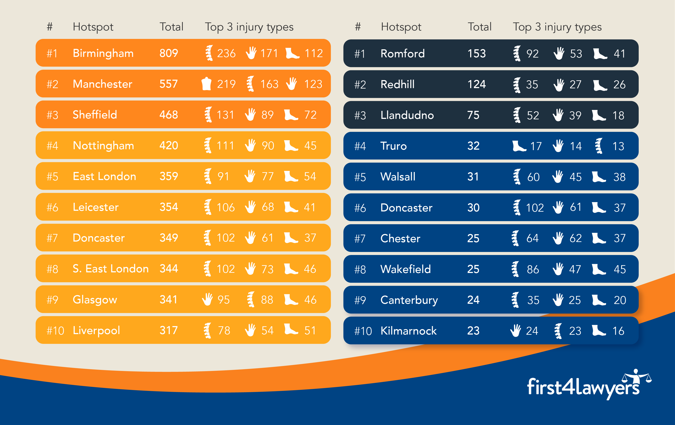
Discussing the research findings, Jacqueline Busby, Head of Claims at First4Lawyers says:
“This research reveals that chest injuries are particularly prevalent in Manchester. These injuries can be caused by a multitude of workplace hazards including falls due to slippery floors and the lifting of heavy goods.
“Although it is positive that numbers of serious workplace accidents, including fatalities, has fallen significantly in the last few decades, we are still seeing too many people being hurt in preventable incidents.
“It is perhaps unsurprising that big cities top the list of accident at work hotspots. However, when we look at the number of accidents per capita, there are some much smaller towns making up the top 10. This shows employers all across the country need to be mindful of how they keep their workers safe.
“We have also found that there is a wide range of injuries happening to employees – from cuts on hands to dislocated backs. Although injuries are more likely to affect individuals in certain
roles, it is a reminder that no worker is completely free of risk.”
For more information and expert insight on the workplace accident hotspots in the UK, visit: https://www.first4lawyers.com/workplace-accident-hotspots-revealed/
—
Sources
The number of claims analysed in this study represents 20,161 claims across 122 UK locations with First4Lawyers receiving an average of over 115,000 enquiries a year. First4Lawyers receives workplace accident enquiries as well as enquiries regarding medical negligence, personal injury, and road traffic accidents.