
Why the Darzi report highlights yet another health challenge for employers to consider…
Lord Darzi’s initial independent investigation of the NHS in England was published on the 12th September and makes for difficult reading. Indeed the summary of Darzi’s findings starts with the less than promising sub-heading;
“The NHS is in serious trouble”
And concludes with the only marginally more upbeat;
“The NHS is in critical condition, but its vital signs are strong”
The paragraphs in between these two worrying headlines are a litany of genuine problems and challenges for the nation’s health service, many of which stem from the years of austerity before 2020.
How long?
So bleak were the findings that Lord Darzi concluded that it would take more than one parliamentary term to clear the waiting lists and return to performance standards, and Prime Minister Starmer subsequently suggested this process would take a decade or more.
The obvious conclusion for employers is that reliance on the NHS to return ill or injured workers quickly and efficiently to the workplace is not a sensible option to maintain attendance and productivity. It follows that the continued need for better workplace wellbeing and healthcare support remains a must-have for employers and employees alike.
Healthy Life Expectancy
Yet in this post I am looking beyond the main media headlines, and I will instead focus on one specific point mentioned in the main text of the 163-page Darzi Report. For I was particularly struck by the reduction to healthy life expectancy in recent years.
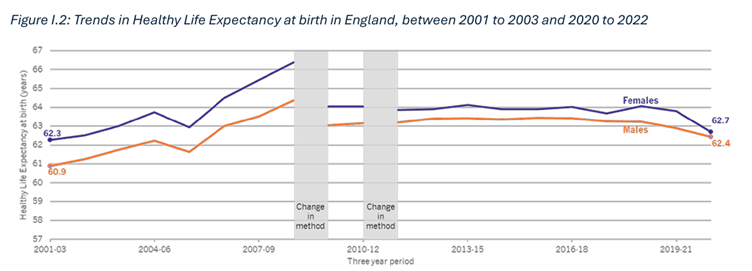
Readers will note that healthy life expectancy (the proportion of life that an individual can expect to live in good health) has dropped significantly from the highs being estimated before the 2007 financial crisis, and that the healthy life expectancy of females (62.7 years) is now close to that of males (62.4 years).
So, at least for the moment, any previous gains achieved in healthy life expectancy this century have been mostly offset by the economic and health challenges the nation has experienced.
What about retirement age?
This fact overlooks another – more hidden challenge – and that relates to falling healthy life expectancy when the state retirement age is heading in the other direction.
In the year 2000 the state retirement age for men was 65, for women 60. On average more women would therefore have reached retirement age with no significant health issues, and therefore posed fewer potential absence problems for their employers.
Yet the retirement age for women was then equalised to match the male retirement age of 65, and both sexes have subsequently seen their state retirement age increase to 67, and there are certainly no guarantees that the state retirement age will not increase further in the years ahead.
Employment absence rates
It follows that the combination of a reduction in healthy life expectancy and the increase to state retirement age could – and perhaps will – lead to increased levels of workplace absence for older workers.
Add to this the wider demographic changes leading to a greater reliance on older workers in the UK, and it is easy to see that this convergence of factors suggests that the challenges of maintaining worker health and wellbeing may be even greater in 2025 and beyond than it was at the start of the century. And that absence challenge is even more urgent given the still sluggish nature of national and business productivity and growth.
My conclusion is that employers will need to think even more carefully around their offering to keep workers fit, healthy, at work, and (of course) productive. For many that will mean a greater focus on prevention rather than cure, and I fully expect improved wellbeing to lead the employer response to these challenges in the years immediately ahead.

Steve Herbert, Employee Benefits & HR Commentator, Keynote Speaker, & Presentation Skills Coach