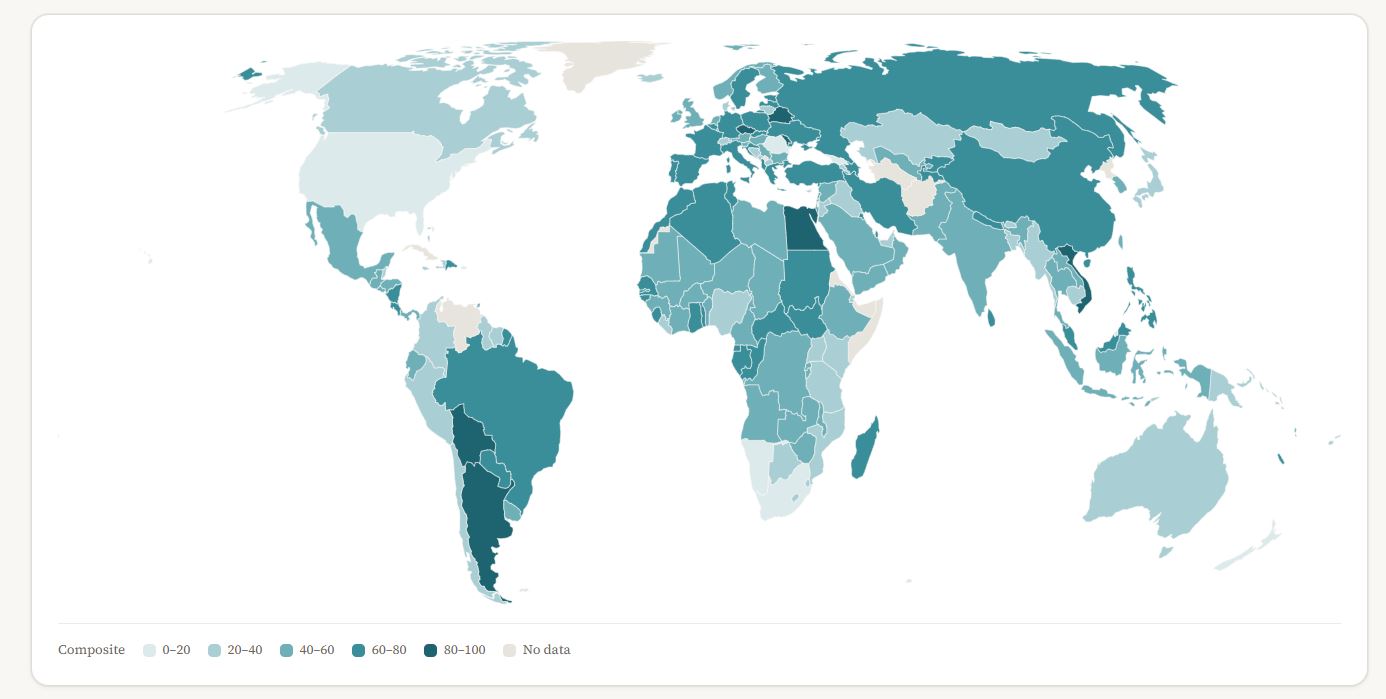
Independent advisory platform for international hiring, Employ Borderless, today announced the launch of its “2026 Global Employer Burden Index”. This data study analysed the statutory hiring regulations of 192 countries and territories, exposing a stark global divide between total salary costs and the hidden financial and legal compliance burdens imposed on businesses by local governments.
By evaluating nations across three core pillars – mandatory employer social costs such as Social Security and healthcare taxes, statutory severance pay, and statutory notice periods – the index also found that English-speaking countries cluster at the lighter end, with statutory employer burden low even where total labour costs run high.
While both the United States and the United Kingdom carry high baseline salary expectations, the index shows that both nations sit at the lower end of the statutory burden spectrum. The United States ranks 158th out of 192 countries and territories with a composite score of 13.9 out of 100. With no federal mandates for severance pay or employee notice periods and an employer social contribution average of 8.1%, the US is among the lowest-burden large economies in the index. To put the gap in dollar terms, a $50,000 hire costs around $54,000 a year in the United States once statutory contributions are added, against around $69,500 in Argentina.
Meanwhile, the United Kingdom ranks 85th globally with a composite score of 47 out of 100. Geographically embedded in Europe, the UK sits well below its continental neighbours on statutory burden, backed by a 13.7% employer social contribution rate and baseline termination laws averaging 4 weeks for severance and 5.3 weeks for notice.
This positions both nations in the lighter, business-friendly half of the index, part of a broader pattern across English-speaking economies. Ireland (#94), Australia (#103), Canada (#109), and New Zealand (#163) all sit in the lighter half – four of six major English-speaking economies below the global midpoint on statutory employer burden.
On a broader scale, the index confirms that Europe is the heaviest region globally for statutory employer burdens, averaging a composite score of 51.7 compared to 29.1 for Oceania, the world’s lightest region. Major European economies carry significant regulatory weight, with countries like Czechia (#3), Germany (#10), and France (#17) levying heavy employer social contributions alongside months of mandatory notice and severance. France, for example, reached a 36.3% employer social contribution rate.
On a country-by-country basis, Latin America and Eastern Europe dominate the most burdensome places in the world to employ staff. Argentina carries the world’s heaviest employer burden at rank 1 with a composite score of 85.9, requiring employers to add a 28.3% social contribution rate on top of 23.1 weeks of statutory severance, 7.2 weeks of notice, and a mandatory 13th-month salary. It is followed by Belarus at rank 2, which carries a 34.3% employer social contribution rate, and Czechia at rank 3. Vietnam and Egypt round out the top five, with Vietnam mandating an average of 24.6 weeks of statutory severance and Egypt requiring 26.7 weeks, one of the longest severance obligations in the index.
At the other end of the spectrum, New Zealand ranks 163rd with a composite score of 4.2, the lowest in the index, with no statutory severance and no statutory notice period. Romania (#162) and Micronesia (#161) are the next lightest.
Robbin Schuchmann, Co-founder of Employ Borderless, commented:
“Most companies making their first international hire look at the gross salary and assume that is the cost. The data says otherwise. A $50,000 hire costs around $69,500 in Argentina once you add statutory contributions and mandatory 13th-month pay – against $54,000 in the US. That $15,500 difference is set entirely by law before a single benefit has been negotiated. The US and UK give employers a lot of room by statute. Much of Europe and Latin America do not. We built this index so that gap is visible before someone commits to a hire.”
The complete interactive dataset, global heat map, and insights report from the 2026 Employer Burden Index can be accessed at employborderless.com/