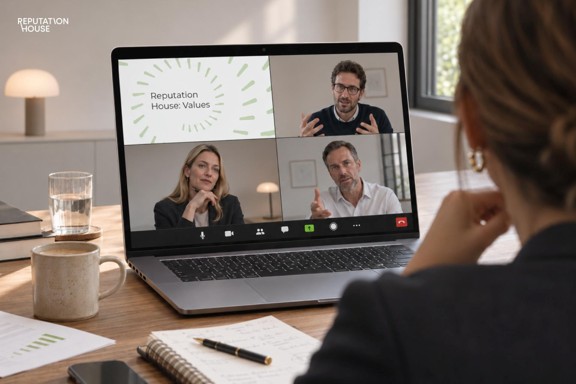
Company values are relatively easy to agree on when everyone is sitting in the same room. Reputation House has a different setup for building company values: employees work across 14 countries and three continents. Different cultures and working contexts are part of everyday collaboration, which makes building corporate values for the remote team a practical question rather than a branding exercise.
Rather than starting with an aspirational list, the company worked from behaviours and practices that were already part of everyday work. That makes Reputation House employee reviews a useful source of context, as they often describe the same everyday practices the values are built around. The framework is revisited once a year as the team and its ways of working change.
Values Come from Practice, Not Declarations
Public lists of corporate values usually show the end result. They rarely tell you much about the working habits and decisions that gave those values their meaning in the first place.
At Reputation House, existing practices provided that grounding. Feedback, learning, onboarding, day-to-day decisions, and the way colleagues support one another were already part of working life. Looking at those patterns meant the company could describe a culture that Reputation House employees knew rather than an ideal version they were being asked to adopt.
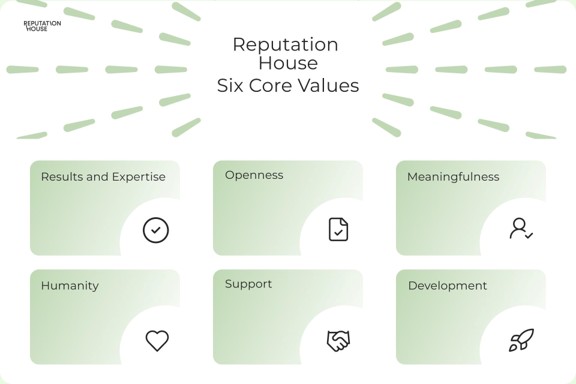
The result was a set of six values: Results and Expertise, Openness, Meaningfulness, Humanity, Support, and Development. Each has a practical counterpart in the way people work.
That connection is particularly useful in a distributed company. Reputation House employees are spread across 14 countries, without a single office providing the same informal context for everyone. Shared principles have to make sense in situations that happen across different teams and locations.
For companies considering how to build company values, this suggests a useful starting point. Look at the behaviours that have already become part of ordinary work before deciding how to describe them. The wording comes later.
Who Shapes the Values: Leaders Across the Company
The values weren’t developed by HR alone. Leaders of every function at Reputation House took part in the discussion.
Their involvement brought the conversation closer to situations managers were already dealing with in their teams. They could consider whether the principles being discussed made sense when setting expectations, giving feedback, making decisions, supporting colleagues, or taking responsibility for results.
This also gave different parts of the business a voice before the wording was settled. A principle that feels relevant in one function may be understood differently in another, especially in a company whose teams work across countries and time zones. Discussing it together made those differences visible while there was still room to address them.
Managers would eventually be working with the values in their own teams, so involving them only after the process was complete would have limited their role to communication. At Reputation House, leadership involvement came earlier.
That is the useful part of the corporate values process for other organizations as well. If managers are expected to refer to company values when they give feedback, set priorities, or make decisions, they should be part of the discussion that shapes them. The same principles provide context when leaders participate in selecting candidates for a Reputation House vacancy.
Corporate Values Examples: Openness and Meaningfulness in Everyday Work
Openness in company culture is easiest to see in the way feedback is handled. It includes transparent decisions, accessible leaders, and room for direct conversations about meaningful work. Self Review is one place where that happens.
Introduced in early 2025, Self Review applies to all Reputation House employees. It takes place at the end of probation and three months after a move to a new position. Employees look back at their own work before discussing the period with their manager and HR, so their assessment becomes part of the conversation rather than something they only receive from someone else.
Reflection Sessions offer another route. Participation is voluntary, and employees choose who they want feedback from. They prepare a presentation covering achievements, difficulties, and lessons learned, then discuss it with the colleagues they’ve invited.
Meaningfulness is visible less through a particular HR format and more through the way work is approached. Employees are expected to understand why a task or process exists and how it connects with wider company goals. A process shouldn’t continue simply because it has become routine.
The other values appear in more concise ways:
- Results and Expertise connects professional knowledge with responsibility for outcomes.
- Humanity is reflected in how people are treated in feedback and everyday work.
- Support is visible in shared responsibility for helping new employees adapt.
- Development includes ongoing learning through formats such as STEP.
The point isn’t to attach a value label to every HR practice. These examples simply show where principles that could otherwise remain abstract become visible in ordinary work.
Annual Review: Why Values Change with the Company
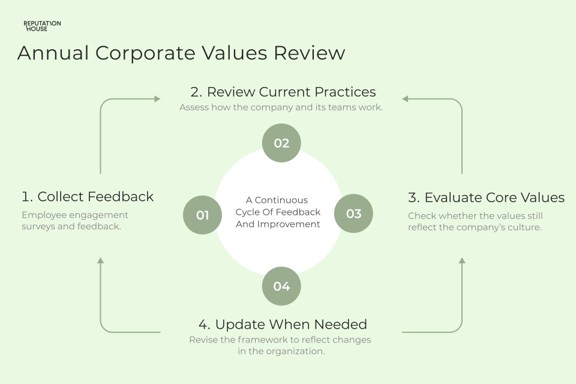
Reputation House returns to its values once a year. By then, the company may have grown, teams may be working differently, and practices that felt important twelve months earlier may no longer describe the culture quite as well.
The review isn’t about finding new words for the sake of it. It’s a check on whether the values still match the company people actually work in. Keeping an outdated formulation simply because it has already been approved would defeat the point.
Employee engagement and feedback give the company another way to make that check. The company tracks engagement through eNPS and Gallup Q12 surveys. Survey findings are followed by action plans, with the results communicated back to employees.
There is external recognition as well: Reputation House received two Stevie Awards: Engagement/Happiness Team of the Year (2025) and Achievement in Managing a Remote Workforce (2026). Together with the engagement data, they give some context for how employees are experiencing the culture behind the stated values.
A corporate values review doesn’t have to mean that something went wrong. Sometimes the company simply isn’t the same company it was a year ago. The useful question is whether its values have kept up.
What Other Companies Can Take from This
Building shared values in a remote team across different countries doesn’t require finding principles broad enough for everyone to agree with. The Reputation House case points to a more practical place to start: the way people already work.
So, here’s a tip on how to build company values. Look at the behaviours that keep showing up, involve the managers who see those behaviours every day, and give the resulting values somewhere to live beyond a company page. Then come back to them. A growing organization may find that what described its culture a year ago no longer fits quite as well.
Building company values is only one part of understanding an employer. After looking for Reputation House vacancies, the next step is bringing together different sources of information. Current vacancies show how the company presents its opportunities today, while Reputation House employee reviews add personal perspectives that help place those values into a broader real-world context.