
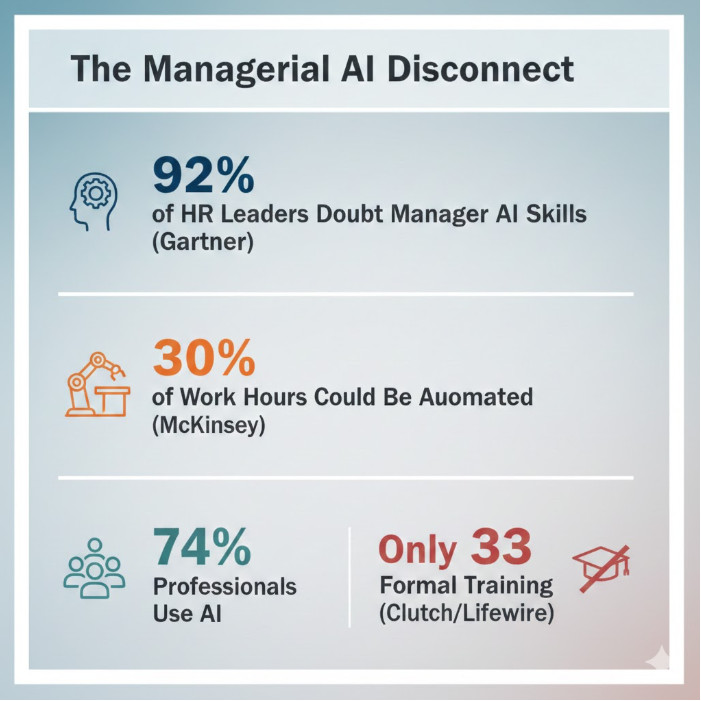
A structural crisis is emerging at the heart of the modern corporation’s AI strategy. The threat is immediate: a McKinsey Global Institute report estimates that 30% of current work hours in advanced economies, primarily routine managerial tasks like reporting, scheduling, and basic analysis, could be automated by 2030.
Yet, management is acutely unprepared.
A Gartner survey found that only 8% of HR leaders believe their managers have the skills to effectively use AI, a blunt assessment that means 92% are seen as untrained. This massive capability gap creates a systemic operational risk: AI capability is rising fast, but managerial readiness is not keeping pace.
The Training Illusion: Managers Are Self-Teaching, Without Guardrails
The capability gap isn’t simply “managers vs. employees”; it’s about uneven usage and weak training, leading to what we call Shadow Adoption. AI is already woven into daily work, yet organizations haven’t built a matching layer of skills and confidence around it.
Managers are rapidly adopting AI tools, often without formal guidance.
- UK data from Corndel’s Workplace Training Report shows that around 71% of middle managers already use AI in their daily tasks. The picture that emerges is not that “employees aren’t using AI,” but that adoption is patchy, often manager-led, and crucially, under-trained.
- US data points in the same direction. A Clutch workplace survey finds that about 74% of professionals use AI at work, but only 33% have had formal AI training. The vast majority are effectively self-teaching tools like ChatGPT and Gemini, often without clear organizational guardrails, policies, or support.
“Right now, most companies have skipped from ‘Should we use AI?’ straight to pushing tools into workflows, without teaching managers how to bring their teams with them,” says Anirudh Agarwal, CEO of OutreachX. “We see managers experimenting in silos while employees are left guessing what’s safe, what’s allowed, and what ‘good’ AI use even looks like. Until organizations invest in manager-led, team-level training, AI will feel like something done to employees, not with them.”
The ‘Performative Fluency’ Crisis: Executives Admit They’re Faking AI Knowledge
On top of the adoption gap sits a striking pattern of performative fluency among leadership that creates a massive credibility and trust problem.
According to Pluralsight’s 2025 AI Skills Report, 79% of professionals admit they have pretended to know more about AI than they actually do. Among the C-suite, that figure jumps to an astonishing 91%, with executives confessing they have exaggerated their AI knowledge at work.
This disconnect is toxic to trust. Executives talk confidently about AI strategy and productivity gains, while privately acknowledging they’re out of their depth. This is the root cause of the Gartner numbers: just 8% of HR leaders are willing to say managers are truly equipped. The risk is clear: AI is increasingly involved in decisions about workload, performance, promotion, and restructuring. When managers can’t explain how AI is being used, what its limits are, or how mistakes will be handled, trust on the front line erodes fast. This is no longer a story about a few missing hires; it’s a structural skills problem inside the existing workforce.
From AI Project to AI-Ready Manager: How to Close the Gap
AI fluency, the ability to use and manage AI tools, not build them, is becoming a core requirement for mid- and senior-level roles. World Economic Forum analysis projected that 39% of core skills will change by 2030 as AI reshapes work. The precise percentage is less important than the trajectory: the skills mix for managers is being rewritten in real time. The through-line is simple: AI capability is advancing faster than managerial capability, and the gap will not close through recruitment alone.
The next critical decision for organizations is not which model to deploy, but which managers to develop.
Treating AI purely as a technology rollout pushes more automation into a layer that HR leaders already see as under-skilled. Treating manager AI fluency as a core leadership competency, by contrast, means building in-role practice: reading model outputs critically, setting guardrails, involving teams in how AI is used, and aligning training with what employees actually receive, not just what HR believes it provides.
Organizations that make that shift will turn AI from a board slide into a durable source of performance and trust. Those that don’t may discover that, in the age of AI, the real competitive divide isn’t who has the most powerful systems, it’s who has managers capable of keeping up with them.